SQL Injection in 2026: Still a Problem, Here's How to Stop It
SQL injection remains a top vulnerability. Learn how SQLi works, why ORMs are not enough, and how to prevent it with parameterized queries and defense in depth.
Infrastructure engineer with 10+ years building production systems on AWS, GCP,…
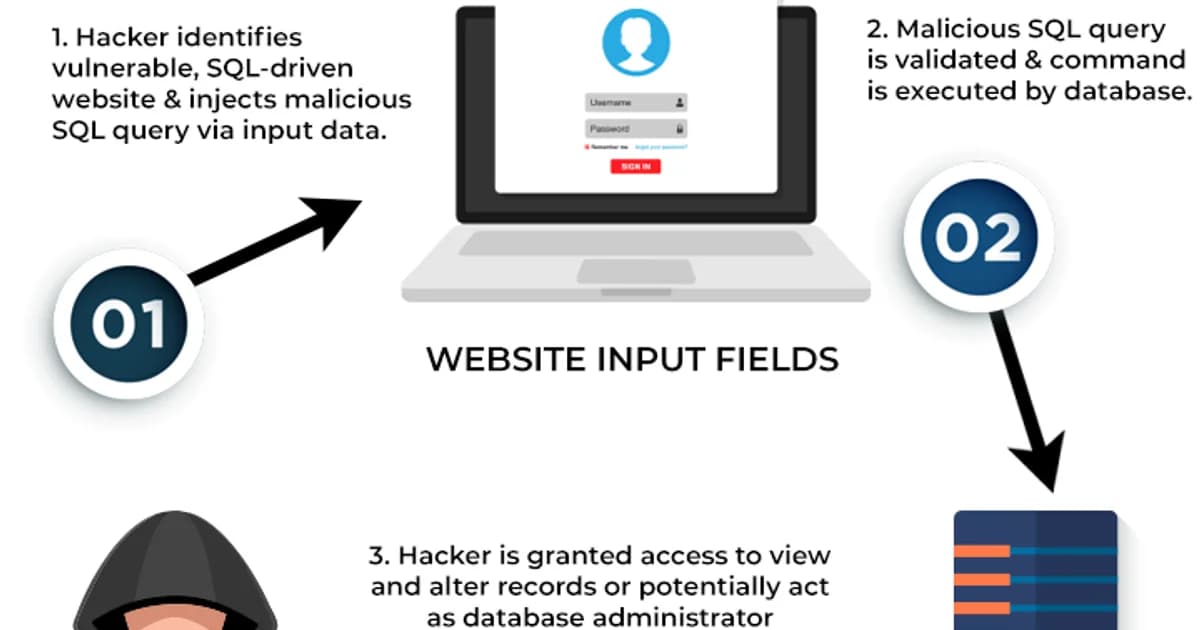
The Search Box That Exfiltrated 2.3 Million User Records
On a Tuesday afternoon in early 2025, a mid-size payment processor lost 2.3 million customer records -- names, hashed passwords, partial card numbers, transaction histories. The point of entry was not a zero-day in a third-party library. It was not a supply-chain attack. It was a search box on an internal admin tool that concatenated request.args['q'] into a SQL LIKE clause. The admin tool was behind a VPN, so the team had marked it "low risk" and skipped the parameterization audit. An attacker with stolen VPN credentials spent 40 minutes paging through information_schema, then another four hours dumping every table the admin DB user had read access to -- which was all of them.
That breach is not remarkable. It is representative. MOVEit in 2023, half a dozen healthcare systems in 2024, and this payment processor in 2025 all trace back to the same 1998-era bug: user input concatenated into a SQL string. The attack surface has shifted from public forms to internal tools, admin panels, and stored procedures, but the root cause has not moved since Phrack 54. SQL injection is still OWASP top three in 2026 because we keep finding new places to make the same mistake.
This guide walks through how SQL injection actually works in 2026 -- classic, blind, and second-order -- plus the specific edge cases that slip past ORMs, code review, and static analysis. If you write code that touches a database, you need to understand these patterns deeply, because "we use an ORM" is not a defense.
How SQL Injection Works
The fundamental problem is mixing data with code. When user input becomes part of a SQL statement, the database can't distinguish between the developer's intended query and the attacker's injected commands.
Classic Example
# VULNERABLE -- never do this
username = request.form['username']
password = request.form['password']
query = f"SELECT * FROM users WHERE username = '{username}' AND password = '{password}'"
cursor.execute(query)
If the attacker enters ' OR '1'='1' -- as the username, the query becomes:
SELECT * FROM users WHERE username = '' OR '1'='1' --' AND password = ''The -- comments out the password check. '1'='1' is always true. The query returns all users, and the attacker logs in as the first user -- usually the admin.
Step-by-Step Attack Flow
- Identify injection point. The attacker tests inputs by adding single quotes, SQL keywords, or boolean conditions to see if the application behaves differently.
- Determine database type. Error messages, response timing, or behavioral differences reveal whether it's PostgreSQL, MySQL, SQL Server, or SQLite.
- Extract data. Using UNION SELECT, subqueries, or blind techniques, the attacker reads table names, column names, and data from any table the database user can access.
- Escalate access. With database access, the attacker may read credentials for other systems, modify data, create admin accounts, or in some cases execute OS commands.
Types of SQL Injection
In-Band SQLi (Classic)
The attacker sends the payload and receives the result in the same HTTP response. This includes error-based injection (the database error message reveals data) and UNION-based injection (the attacker appends a UNION SELECT to extract data from other tables).
-- UNION-based extraction: steal all usernames and passwords
' UNION SELECT username, password FROM users --
Blind SQL Injection
The application doesn't display database errors or query results, but the attacker can still extract data by asking true/false questions:
-- Boolean-based blind: check if the first character of the admin password is 'a'
' AND (SELECT SUBSTRING(password, 1, 1) FROM users WHERE username='admin') = 'a' --

-- Time-based blind: if the condition is true, the response is delayed
' AND IF((SELECT SUBSTRING(password, 1, 1) FROM users WHERE username='admin') = 'a', SLEEP(5), 0) --
Blind injection is slower but equally devastating. Tools like sqlmap automate the extraction process, testing hundreds of conditions per second.
Second-Order SQL Injection
This is the one that bites experienced teams. The malicious input is stored safely (properly escaped or parameterized on insert) but then used unsafely in a later query. Example: a user registers with the username admin'--. The registration query is parameterized and works fine. But a password reset function later concatenates the username from the database into a new query:
# The username was stored safely, but now it's used unsafely
stored_username = get_username_from_db(user_id)  # Returns: admin'--
query = f"UPDATE users SET password = '{new_password}' WHERE username = '{stored_username}'"
# Becomes: UPDATE users SET password = 'newpass' WHERE username = 'admin'--'
# This resets the actual admin's password
Watch out: Second-order injection passes most security reviews because the input is handled safely at the boundary. The vulnerability is in the internal code path that trusts data from the database. Every query must be parameterized, even when the input comes from your own database.
Why ORMs Don't Make You Immune
ORMs (Object-Relational Mappers) like SQLAlchemy, Prisma, Django ORM, and ActiveRecord use parameterized queries by default. That's great. But every ORM provides an escape hatch for raw SQL, and developers use them more than they should:
# Django ORM -- safe
User.objects.filter(username=user_input)

# Django ORM -- VULNERABLE raw query
User.objects.raw(f"SELECT * FROM auth_user WHERE username = '{user_input}'")
// Prisma -- safe
await prisma.user.findMany({ where: { username: userInput } });
// Prisma -- VULNERABLE raw query
await prisma.$queryRawUnsafe(`SELECT * FROM users WHERE username = '${userInput}'`);The pattern is consistent: ORMs are safe until you bypass them. Audit every use of raw(), execute(), $queryRawUnsafe(), or any method that accepts a SQL string. These are injection points regardless of what ORM you use.
How to Prevent SQL Injection
1. Always Use Parameterized Queries
This is the primary defense. Parameterized queries (also called prepared statements) separate the SQL structure from the data. The database knows which parts are code and which are values.
# Python (psycopg2) -- parameterized
cursor.execute("SELECT * FROM users WHERE username = %s AND password = %s", (username, password))

# Node.js (pg) -- parameterized
await client.query('SELECT * FROM users WHERE username = $1 AND password = $2', [username, password])
// Java (JDBC) -- PreparedStatement
PreparedStatement stmt = conn.prepareStatement("SELECT * FROM users WHERE username = ? AND password = ?");
stmt.setString(1, username);
stmt.setString(2, password);
ResultSet rs = stmt.executeQuery();2. Input Validation and Allowlisting
Validate input types and formats before they reach any query. If a field should be an integer, parse it as an integer. If it should match a pattern, validate against that pattern. Reject anything that doesn't conform.
3. Least-Privilege Database Accounts
Your application's database user should have the minimum permissions needed. A read-only API endpoint doesn't need INSERT, UPDATE, or DELETE permissions. If the application never needs to DROP tables, the database user shouldn't have that privilege.
-- Create a read-only user for the API
CREATE ROLE api_readonly LOGIN PASSWORD 'strong-random-password';
GRANT CONNECT ON DATABASE production TO api_readonly;
GRANT USAGE ON SCHEMA public TO api_readonly;
GRANT SELECT ON ALL TABLES IN SCHEMA public TO api_readonly;
ALTER DEFAULT PRIVILEGES IN SCHEMA public GRANT SELECT ON TABLES TO api_readonly;
4. Web Application Firewall (WAF)
A WAF can block known SQLi patterns before they reach your application. It's a defense-in-depth layer, not a primary defense. WAFs have blind spots and can be bypassed with encoding tricks. Never rely on a WAF as your only protection.
Testing for SQL Injection
| Tool | Type | Cost | Best For |
|---|---|---|---|
| sqlmap | Automated scanner (OSS) | Free | Comprehensive SQLi testing, extraction |
| Burp Suite Pro | Web security scanner | $449/yr | Manual testing with automated scanning |
| Semgrep | Static analysis (OSS) | Free / paid tiers | Finding raw SQL in code before deployment |
| OWASP ZAP | Web security scanner (OSS) | Free | Automated scanning in CI/CD pipelines |
| Snyk Code | Static analysis | Free tier available | IDE-integrated vulnerability detection |
Pro tip: Add
semgrepto your CI pipeline with ther/python.django.security.injection.sqland equivalent rulesets. It catches raw SQL usage at code review time, which is orders of magnitude cheaper than finding it in production.
Detecting Exploitation in Flight
Prevention is the goal, but detection is the safety net. These are the specific signals that catch SQL injection attempts before they escalate to full exfiltration -- paired with the approximate noise rate I have seen in production, so you know what to expect from each alert.
| Signal | What it catches | False-positive rate |
|---|---|---|
Query references information_schema from app user | Reconnaissance phase of SQLi | < 1% (app DB users rarely need it) |
| Query time exceeds p99 by 20x | Time-based blind injection with SLEEP/WAITFOR | Medium -- needs tuning per endpoint |
| UNION keyword in a query that never had it | UNION-based extraction | Very low for most apps |
| Consecutive query errors from same session | Attacker probing error-based SQLi | Low with rate-limiting (> 5/min) |
| HTTP 500 rate spike on a single endpoint | Attacker triggering errors to leak type info | High without anomaly-detection baseline |
| Rows-returned anomaly (10,000 from a "single user" query) | UNION SELECT dumping a table | Low if you baseline endpoint row counts |
-- PostgreSQL: log any query touching information_schema
CREATE OR REPLACE FUNCTION audit_information_schema()
RETURNS event_trigger AS $$
BEGIN
  RAISE WARNING 'information_schema access by %', current_user;
END;
$$ LANGUAGE plpgsql;

-- Alert rule (Prometheus/Loki): spike in 500s on a single endpoint
sum(rate(http_requests_total{status="500"}[5m])) by (path)
  > 5 * avg_over_time(http_requests_total{status="500"}[1h])
Wire these signals into your SIEM or log aggregation. The information_schema alert alone would have caught the payment-processor breach I opened with four hours before the attacker finished exfiltration -- they spent 40 minutes paging through table names, which generated hundreds of qualifying log lines.
Real-World SQL Injection: What Attackers Actually Do
Textbook SQLi examples show login bypasses. In practice, attackers use SQLi for:
- Data exfiltration -- Dumping entire databases: customer records, payment info, credentials.
- Privilege escalation -- Creating admin accounts or modifying role assignments.
- Lateral movement -- Reading database credentials for other services, or using database-level OS command execution (e.g.,
xp_cmdshellin SQL Server). - Ransomware staging -- Encrypting or deleting database contents and demanding payment.
- Persistent access -- Inserting backdoor accounts or stored procedures that provide ongoing access.
Frequently Asked Questions
Can SQL injection steal data from other tables?
Yes. Using UNION-based injection, an attacker can append queries that read from any table the database user has access to. If the application connects with a privileged account, the attacker can read every table in the database. This is why least-privilege database accounts matter.
Does using an ORM prevent SQL injection?
ORMs prevent injection in their standard query methods because they use parameterized queries internally. However, every ORM provides raw SQL escape hatches that bypass this protection. Any use of raw SQL methods reintroduces the vulnerability. Audit raw query usage in code reviews.
What is the difference between SQL injection and XSS?
SQL injection targets the database by injecting malicious SQL through application inputs. XSS (Cross-Site Scripting) targets the browser by injecting malicious JavaScript into web pages. SQL injection compromises server-side data; XSS compromises client-side sessions and user interactions. Both exploit insufficient input handling.
Can prepared statements be bypassed?
Properly implemented prepared statements cannot be bypassed because the query structure and data are sent to the database separately. However, developers sometimes misuse prepared statements by concatenating input into the query string before passing it to the prepare function, which negates the protection entirely.
How do I detect SQL injection attempts in my logs?
Look for SQL keywords in request parameters: UNION, SELECT, INSERT, DROP, single quotes, double dashes, and semicolons in unusual places. WAFs log blocked attempts. Database slow query logs may show unusual queries. Set up alerts for queries that reference system tables like information_schema.
Is NoSQL immune to injection attacks?
No. NoSQL databases like MongoDB are vulnerable to NoSQL injection, where attackers manipulate query operators. For example, sending {"username": {"$gt": ""}, "password": {"$gt": ""}} as JSON can bypass authentication. The defense is the same: validate input types and use the database driver's parameterization features.
What is sqlmap and is it legal to use?
Sqlmap is an open-source tool that automates SQL injection detection and exploitation. It's legal to use on systems you own or have explicit authorization to test. Using it against systems without permission is illegal in most jurisdictions. It's a standard tool in penetration testing engagements and security audits.
Make It Impossible, Not Just Unlikely
The goal isn't to make SQL injection hard -- it's to make it structurally impossible. Parameterized queries do this at the query level. Least-privilege accounts limit damage at the database level. ORMs help, but only when you don't bypass them. Static analysis catches mistakes before deployment. WAFs provide defense in depth. Layer all of these. SQL injection has persisted for 28 years not because it's sophisticated, but because it only takes one missed parameterization in one endpoint to compromise an entire database.
Written by
Abhishek Patel
Infrastructure engineer with 10+ years building production systems on AWS, GCP, and bare metal. Writes practical guides on cloud architecture, containers, networking, and Linux for developers who want to understand how things actually work under the hood.
Related Articles
Best Vulnerability Scanners for Containers (2026): Snyk vs Trivy vs Grype vs Aqua
Benchmarked comparison of Snyk, Trivy, Grype, and Aqua against 100 production images. Real 2026 pricing, false-positive rates, scan times, and a decision matrix for picking the right scanner.
15 min read
SecurityBest Auth Providers (2026): Auth0 vs Clerk vs Supertokens vs WorkOS vs Supabase Auth
A practitioner comparison of the five dominant auth providers in 2026 -- Auth0, Clerk, Supertokens, WorkOS, and Supabase Auth -- with real pricing tiers, SSO connection math, SOC 2 / HIPAA / FedRAMP coverage, integration code samples, and a decision matrix that maps each vendor to a specific stack and scale.
15 min read
DatabasesPostgres as a Queue: When You Don't Need Kafka or RabbitMQ
Build a production-grade task queue entirely in PostgreSQL using SELECT FOR UPDATE SKIP LOCKED, LISTEN/NOTIFY, exponential backoff retries, and dead-letter handling. Covers PGMQ, Graphile Worker, River, and when a dedicated broker actually earns its keep.
14 min read
Enjoyed this article?
Get more like this in your inbox. No spam, unsubscribe anytime.