The CAP Theorem: What It Actually Means for Your Database Choices
The CAP theorem forces a trade-off between consistency and availability during network partitions. Learn how PostgreSQL, Cassandra, DynamoDB, and other databases handle this trade-off, plus the PACELC extension that captures what CAP misses.
Infrastructure engineer with 10+ years building production systems on AWS, GCP,…
A Twenty-Five-Year Timeline of a Theorem Nobody Reads Correctly
The CAP theorem is the piece of distributed-systems theory most people have heard of and fewest have read. It is also a moving target -- the claim as stated in 2000 is not the claim proved in 2002, and neither is the claim argued by its own author in 2012. The popular "pick two of three" simplification is not in any of those sources. Tracing the actual evolution makes the theorem useful for the first time.
- July 2000 -- Eric Brewer's PODC keynote. Brewer, building large-scale systems at Inktomi, presents "Towards Robust Distributed Systems" and argues informally that a shared-data system cannot simultaneously provide Consistency, Availability, and Partition tolerance. He calls it a conjecture and illustrates it with real systems -- news sites that stayed available during partitions at the cost of stale reads.
- June 2002 -- Gilbert and Lynch's proof. Seth Gilbert and Nancy Lynch at MIT publish a formal proof in ACM SIGACT News. They prove a specific, narrow claim: in an asynchronous network where messages can be lost indefinitely, no protocol can guarantee both linearizability and availability of every read/write to every non-failing node. Everything the theorem formally says is bounded by that setting -- it is not a general law about "two of three."
- 2007-2009 -- The Dynamo era. Amazon's 2007 Dynamo paper and the wave of NoSQL systems it inspired (Cassandra, Riak, Voldemort) frame themselves as "AP" systems. The "pick two" Venn diagram takes over conference slide decks. Teams start choosing databases based on a letter pairing.
- February 2012 -- Brewer's "CAP Twelve Years Later." In an IEEE Computer article, Brewer himself pushes back on the simplification. His correction is blunt: partition tolerance is not optional in any real distributed system, so the real design question is "during a partition, do you choose consistency or availability?" The "2-of-3" reading, he writes, is misleading. Almost nobody updates their slides.
- 2010-2014 -- PACELC sharpens the picture. Daniel Abadi notices CAP says nothing about the normal case -- when there is no partition. He proposes PACELC: if Partition, then A-or-C (as CAP); else, L-or-C (latency vs consistency). This is the model actually worth internalising. Every modern database -- Cassandra, DynamoDB, CockroachDB, Spanner, Cosmos DB -- maps cleanly onto a PACELC classification, and the classification predicts behaviour during both failures and steady state.
- 2017-present -- Spanner, FaunaDB, CockroachDB. Systems with atomic clocks, TrueTime, or clever clock-skew bounds start offering global strong consistency with availability levels that were previously the exclusive territory of AP systems. "Pick two" becomes visibly inadequate -- these systems pick all three during normal operation and only pay the consistency-vs-availability tax during genuine partitions, exactly as Brewer's 2012 revision described.
So here is what the theorem actually is in 2026, stripped of the telephone-game simplifications: during a network partition, a distributed data store must choose between consistency and availability; during normal operation, it must choose between latency and consistency. Everything else in this guide -- how PostgreSQL, Cassandra, DynamoDB, and CockroachDB make those choices, how quorum reads work, what "eventual consistency" means in production, and when to reach for the Saga pattern -- is downstream of that single clarified statement.
The Three Guarantees Explained
Consistency (C)
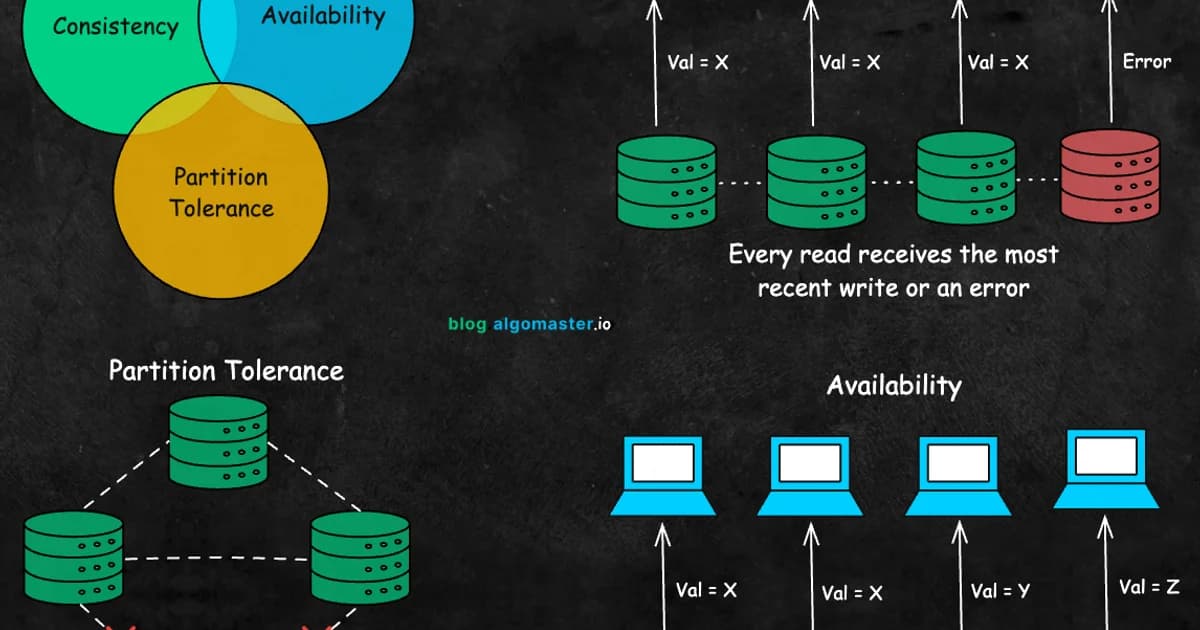
Every read receives the most recent write or an error. All nodes see the same data at the same time. This is linearizability -- the strongest consistency model. If you write a value to node A, a subsequent read from node B must return that value (or a newer one). No stale reads, no divergent state.
Availability (A)
Every request to a non-failing node receives a response, without guarantee that it contains the most recent write. The system never refuses to answer. A node might return stale data, but it always responds. No timeouts, no errors -- just an answer.
Partition Tolerance (P)
The system continues to operate even when network messages are lost or delayed between nodes. Partitions are not theoretical -- they happen in every distributed system that runs long enough. Google's Chubby team documented that network partitions occur regularly even within a single datacenter.
Watch out: The "C" in CAP is not the same as the "C" in ACID. ACID consistency means a transaction moves the database from one valid state to another. CAP consistency (linearizability) means all nodes see the same data at the same time. Confusing these two is one of the most common mistakes in distributed systems discussions.
Why "Pick Two" Is Misleading
The classic Venn diagram showing CA, CP, and AP systems is everywhere -- and it's a terrible mental model. Here's why:
- Partition tolerance is not optional -- in a distributed system, network partitions will happen. You can't choose to not have them. A "CA" system is just a single-node database.
- The trade-off only applies during partitions -- when the network is healthy, you can have both consistency and availability. It's only when nodes can't communicate that you must choose.
- The choice isn't binary -- real systems don't cleanly fall into "CP" or "AP." They make nuanced trade-offs at different levels of the stack, often on a per-operation basis.
- Latency matters too -- even without a partition, a system that takes 30 seconds to return a consistent read isn't practically "available." The PACELC theorem addresses this.
CP vs AP: What Databases Actually Choose
| Database | CAP Classification | During Partition | Consistency Model | Best For |
|---|---|---|---|---|
| PostgreSQL (single node) | CA (not distributed) | N/A -- single node | Strong (ACID) | Transactional workloads |
| PostgreSQL (sync replication) | CP | Refuses writes if replica unreachable | Strong | Financial systems, inventory |
| MySQL (Group Replication) | CP | Blocks on minority partition | Strong | Relational workloads needing HA |
| MongoDB | CP (default) | Primary unavailable during election | Strong (with majority write concern) | Document-oriented applications |
| Cassandra | AP (tunable) | Continues serving reads/writes | Eventual (tunable per query) | Time-series, IoT, high write throughput |
| DynamoDB | AP (default) | Continues serving, eventual consistency | Eventual (strongly consistent reads optional) | Serverless, key-value access patterns |
| CockroachDB | CP | Unavailable on minority partition | Serializable | Global SQL with strong consistency |
| etcd / Consul | CP | Read-only or unavailable without quorum | Linearizable | Configuration, service discovery |
| Riak | AP | Continues serving, uses vector clocks | Eventual | High availability key-value |
Eventually Consistent: What That Actually Means
When Cassandra or DynamoDB says "eventually consistent," they mean: if you stop writing, all replicas will converge to the same state after some time. That "some time" is usually milliseconds -- but there are no hard guarantees.
The practical implications are real:
- Read-after-write inconsistency -- you write a value and immediately read it back from a different node. You might get the old value.
- Stale reads -- a user updates their profile, refreshes the page, and sees the old data. The write hasn't propagated yet.
- Conflict resolution -- two clients write different values to the same key on different nodes during a partition. Who wins? Last-write-wins (LWW) is common but lossy. CRDTs and vector clocks are alternatives.
Pro tip: DynamoDB offers strongly consistent reads as an option -- but they cost twice as much in read capacity units and can only be served by the leader node. Use them selectively for operations where stale data would cause business problems (account balances, inventory counts) and accept eventual consistency everywhere else.
How to Decide: A Step-by-Step Framework
When choosing between CP and AP systems, work through this decision process:
- Identify your data domains -- not all data has the same consistency requirements. User profiles can be eventually consistent. Financial transactions cannot.
- Quantify your availability requirements -- if you need 99.99% uptime across regions, CP systems with synchronous replication will struggle. AP systems handle this naturally.
- Determine your partition strategy -- are you running multi-region? Multi-AZ? Single datacenter? More geographic spread means more partition risk.
- Map the business impact -- what happens when a user sees stale data? If it means showing an out-of-stock item as available, that's a real cost. If it means a social media post appears 500ms late, nobody notices.
- Consider tunable consistency -- Cassandra lets you set consistency levels per query. DynamoDB lets you choose strongly consistent reads. You don't have to commit to one model for everything.
The PACELC Theorem: CAP's Smarter Sibling
Daniel Abadi proposed PACELC in 2010 to address CAP's biggest blind spot: what happens when there is no partition? The PACELC theorem says:
Definition: PACELC extends CAP: if there is a Partition, choose between Availability and Consistency (like CAP). Else, when the system is running normally, choose between Latency and Consistency. This captures the trade-off that exists even without failures.
This is closer to the real-world trade-off. Even when the network is healthy, a system that synchronously replicates to three nodes before acknowledging a write will be slower than one that acknowledges immediately and replicates asynchronously. PACELC captures this latency/consistency trade-off that CAP ignores.
| Database | Partition (PA/PC) | Else (EL/EC) | Full Classification |
|---|---|---|---|
| PostgreSQL (sync) | PC | EC | PC/EC -- consistent everywhere |
| Cassandra | PA | EL | PA/EL -- fast and available |
| DynamoDB | PA | EL | PA/EL -- fast and available |
| MongoDB | PC | EC | PC/EC -- consistent everywhere |
| CockroachDB | PC | EC | PC/EC -- consistent with latency cost |
| Cosmos DB | PA (tunable) | EL (tunable) | Tunable across five consistency levels |
Practical Patterns for Working Within CAP Constraints
Read Your Own Writes
The most common complaint with eventually consistent systems: "I just saved my data and it's not there." Solve this by routing reads to the same node that handled the write, at least for the writing user. DynamoDB's strongly consistent reads, session affinity, or client-side caching all work.
Quorum Reads and Writes
Cassandra's tunable consistency lets you require a quorum (majority of replicas) for reads and writes. With a replication factor of 3, setting both read and write consistency to QUORUM (2 of 3 nodes) gives you strong consistency without sacrificing partition tolerance entirely.
-- Cassandra: quorum read for strong consistency
SELECT * FROM orders WHERE order_id = 'abc-123'
USING CONSISTENCY QUORUM;

-- Cassandra: quorum write
INSERT INTO orders (order_id, total, status)
VALUES ('abc-123', 99.99, 'confirmed')
USING CONSISTENCY QUORUM;
The formula: if R + W > N (read replicas + write replicas > total replicas), you get strong consistency. With N=3, R=2, W=2 satisfies this. But you trade availability -- if two nodes are down, neither reads nor writes succeed.
Saga Pattern for Cross-Service Consistency
When a business transaction spans multiple services (and multiple databases), you can't use a single ACID transaction. The Saga pattern breaks the transaction into a series of local transactions, each publishing an event that triggers the next step. If any step fails, compensating transactions undo the previous steps.
1. Order Service:  Create order (PENDING)
2. Payment Service: Charge card
   -- If fails: Cancel order (compensating transaction)
3. Inventory Service: Reserve stock
   -- If fails: Refund card, cancel order
4. Order Service: Mark order CONFIRMED
Managed Database Pricing Comparison
Your CAP trade-off choice also has cost implications. Here's what managed options cost for a moderate workload (multi-AZ, ~500 GB storage, production-grade):
| Service | Type | CAP Class | Estimated Monthly Cost | Notes |
|---|---|---|---|---|
| Amazon RDS PostgreSQL | CP | db.r6g.large, Multi-AZ | $350 - $500 | Synchronous replication to standby |
| Amazon DynamoDB | AP | On-demand mode | $200 - $800 | Scales to zero; pay per request |
| Amazon Keyspaces (Cassandra) | AP | Serverless | $300 - $700 | Cassandra-compatible, no cluster management |
| CockroachDB Dedicated | CP | 3-node cluster | $500 - $1,200 | Distributed SQL with serializable isolation |
| MongoDB Atlas | CP | M30 cluster | $400 - $700 | 3-node replica set, automated failover |
| Azure Cosmos DB | Tunable | 400-4000 RU/s | $200 - $1,500 | Five consistency levels, global distribution |
Frequently Asked Questions
Is the CAP theorem still relevant in 2026?
Yes, but it's best understood alongside PACELC. CAP correctly identifies the fundamental trade-off during network partitions, but PACELC gives you a more complete picture by including the latency/consistency trade-off during normal operation. Both are useful mental models for evaluating distributed databases.
Can a database be both consistent and available?
Yes -- when there's no network partition. During normal operation, a well-configured PostgreSQL cluster provides both strong consistency and high availability. The trade-off only kicks in during partitions. A single-node database is trivially CA, but it's not distributed and has a single point of failure.
What does "tunable consistency" mean in Cassandra?
Cassandra lets you set consistency levels per query rather than per cluster. You can write with QUORUM consistency for financial data and ONE consistency for analytics events. This per-query flexibility means you don't have to choose a single consistency model for all your data.
Why do people say partition tolerance is mandatory?
Because network partitions are not a design choice -- they're a physical reality. Networks fail, routers crash, cables get damaged. Any system with more than one node will eventually experience a partition. Choosing "no partition tolerance" means accepting that the system stops working entirely when the network hiccups.
How does DynamoDB handle consistency?
DynamoDB defaults to eventually consistent reads, which are cheaper and faster. You can request strongly consistent reads per query, which always return the most recent write but cost double the read capacity. DynamoDB Global Tables use last-writer-wins conflict resolution across regions.
What is the difference between strong consistency and eventual consistency?
Strong consistency guarantees every read returns the latest write. Eventual consistency guarantees that all replicas will converge to the same state given enough time, but a read might return stale data. The latency difference can be significant -- strongly consistent reads must contact the leader node.
When should I choose an AP database over a CP database?
Choose AP when your application can tolerate stale reads, needs to remain operational during network failures, and prioritizes write availability. Common use cases include IoT sensor data, social media feeds, shopping carts, and session stores -- anywhere a few milliseconds of staleness won't cause business harm.
Making the Right Choice
The CAP theorem isn't about picking your favorite two letters. It's about understanding that network partitions are inevitable and deciding what your system does when they happen. For most applications, the answer isn't one database -- it's different databases for different data domains. Use PostgreSQL for your financial transactions, DynamoDB for your session store, and Cassandra for your time-series telemetry. Let each data domain's consistency requirements drive the technology choice, not the other way around.
Written by
Abhishek Patel
Infrastructure engineer with 10+ years building production systems on AWS, GCP, and bare metal. Writes practical guides on cloud architecture, containers, networking, and Linux for developers who want to understand how things actually work under the hood.
Related Articles
Postgres as a Queue: When You Don't Need Kafka or RabbitMQ
Build a production-grade task queue entirely in PostgreSQL using SELECT FOR UPDATE SKIP LOCKED, LISTEN/NOTIFY, exponential backoff retries, and dead-letter handling. Covers PGMQ, Graphile Worker, River, and when a dedicated broker actually earns its keep.
14 min read
DatabasesBest Vector Databases for RAG (2026): Pinecone vs Weaviate vs Qdrant vs Milvus vs pgvector
Real 2026 pricing, recall benchmarks, and a decision matrix for picking between Pinecone, Weaviate, Qdrant, Milvus, and pgvector. When pgvector is enough, when Qdrant wins on cost, and when Milvus is worth the ops burden.
17 min read
ArchitectureCaching Strategies Every Developer Should Know (With Examples)
A practical guide to caching techniques including Redis, CDN caching, database caching, and application-level strategies.
11 min read
Enjoyed this article?
Get more like this in your inbox. No spam, unsubscribe anytime.